
Most “n8n vs Zapier” articles dodge the one thing you actually want to know. What does each tool really cost you, and which one fits your team? Here is the short answer. n8n vs Zapier comes down to a simple trade.
Zapier is a no-code, cloud-only tool built for speed and the widest app library. n8n is a low-code platform you can self-host, built for control, complex logic, and cost at scale.
Choose Zapier when you need a working automation today. Choose n8n when you need ownership, flexibility, and a lower bill as you grow.
If you want a system built and maintained for you, that is the work we do every day at Headway Automation.
This guide uses real June 2026 pricing and verified case studies, not vague claims. Read it once, and you will know exactly which tool to pick.
Key Takeaways
- n8n is free to self-host. You only pay server costs of $6 to $15 per month. Zapier starts at $19.99 per month and costs climb fast.
- Zapier charges per action step (task). n8n charges per full workflow run (execution). At scale, this gap is huge.
- n8n offers native LangChain, AI agents, custom JavaScript and Python, and self-hosting. Zapier offers faster setup and 8,000+ app connectors.
- For regulated industries like healthcare, finance, and government, n8n self-hosted is the only viable option of the two.
- Agencies and developers who build automation for clients are better served by n8n’s open-source flexibility and zero vendor lock-in.
- The hidden cost of self-hosting (maintenance time) is real. Teams without a dedicated automation owner should add it to the total cost.
- Make, Relay.app, and Lindy are real alternatives that fit cases where neither Zapier nor n8n is the best pick.
n8n vs Zapier at a Glance
If you only have a minute, this table gives you the whole picture. n8n wins on cost, control, and code. Zapier wins on setup speed and the size of its app library.
| Factor | n8n | Zapier |
|---|---|---|
| Hosting | Self-hosted (Docker, VPS, Kubernetes) or n8n Cloud | Cloud SaaS only, no self-hosting |
| Pricing model | Per workflow execution (full run = 1 unit) | Per task (each action step = 1 unit) |
| Starting paid price | $20/month cloud (2,500 executions) | $19.99/month (750 tasks) |
| Free plan | Unlimited on self-hosted; community cloud available | 100 tasks/month, 5 Zaps |
| Native integrations | 400+ native nodes + 600+ community nodes | 8,000+ app connectors |
| Custom code | Native JavaScript and Python nodes | Basic JavaScript snippet only |
| AI agent support | Native LangChain, tool-use, memory, RAG pipelines | Basic AI actions via Zaps, no autonomous agents |
| Self-hosting | Yes | No |
| Open-source | Yes (fair-code license) | No |
| Data sovereignty | Full control when self-hosted | All data on Zapier’s US-hosted servers |
| Target user | Developers, technical teams, automation agencies | Non-technical users, marketers, ops teams |
| Vendor lock-in | None, open-source, exportable workflows | High, proprietary format, no workflow export |
What n8n and Zapier Actually Are
Both tools connect your apps and run tasks for you without manual work. The difference is who owns the engine and how much it can do.
n8n is a workflow automation platform launched in 2019 by Jan Oberhauser as an open-source alternative to proprietary tools. The idea is simple. Developers and technical teams should own their automation, not rent it. n8n runs on any server you control, supports native JavaScript and Python inside workflows, and has shipped over 70 AI-specific nodes covering LLMs, embeddings, vector stores, and multi-agent orchestration. By late 2025, n8n had raised $253M across four rounds, reached a $2.5B unicorn valuation, and served over 230,000 active users and 3,000+ enterprise clients worldwide.
Zapier was founded in 2011 and created the modern category of no-code app automation. The pitch has not changed. Connect two apps, set a trigger, set an action, done, with no code. With 8,000+ native connectors and thousands of pre-built templates, Zapier is still the fastest way for a non-technical person to get an automation running. It is fully cloud-hosted and has added Zapier Agents, Zapier Copilot, and an MCP server connecting AI tools to 40,000+ actions. It reportedly made around $310M in revenue in 2024.
| n8n | Zapier | |
|---|---|---|
| Founded | 2019 | 2011 |
| Model | Open-source, fair-code license | Proprietary SaaS |
| Hosting | Self-hosted or n8n Cloud | Cloud only |
| Ideal user | Developer, automation engineer, technical agency | Non-technical user, marketer, ops team |
| Philosophy | You own your automation infrastructure | Click-to-connect simplicity at any scale |
Pricing: What You Really Pay, Not the Sticker Price
Billing is where these two tools split the most, and where most reviews leave you guessing. The rule is short. Zapier charges per task. n8n charges per execution. That one difference decides your bill at scale.
Zapier counts every single action step as one billable task. A 5-step Zap running 1,000 times eats 5,000 tasks. For complex, multi-step work, costs pile up fast. n8n counts the whole run as one execution, no matter how many nodes it holds. A 20-node workflow running 1,000 times uses just 1,000 executions. At any real scale, that gap is enormous.
n8n Pricing (June 2026)
| Plan | Price | Executions | Key Features |
|---|---|---|---|
| Community (Self-Hosted) | Free forever | Unlimited | Full feature set, pay server costs only (~$6–$15/month) |
| Starter (Cloud) | ~$20/month | 2,500/month | Managed cloud, basic logging |
| Pro (Cloud) | ~$50/month | 10,000/month | Advanced logging, debug mode, unlimited workflows |
| Business (Self-Hosted) | ~$667/month billed annually | Unlimited | SSO, Git version control, queue-mode scaling, unlimited users |
| Enterprise | Custom | Custom | Dedicated support, SLA, advanced compliance features |
Zapier Pricing (June 2026)
| Plan | Price | Tasks/Month | Key Features |
|---|---|---|---|
| Free | $0 | 100 | 5 Zaps, single-step Zaps only |
| Professional | $29.99/month | 750 | Unlimited Zaps, multi-step, filters, paths |
| Team | ~$103.50/month | 2,000 | Shared workspace, unlimited users |
| Enterprise | Custom | Custom | SSO, advanced permissions, dedicated support |
Heads Up: Zapier raised its Starter/Professional prices in March 2026. The Professional tier moved from $19.99 to $29.99/month, and the free plan dropped from 5 Zaps to 3 active Zaps.
The cost at real volume
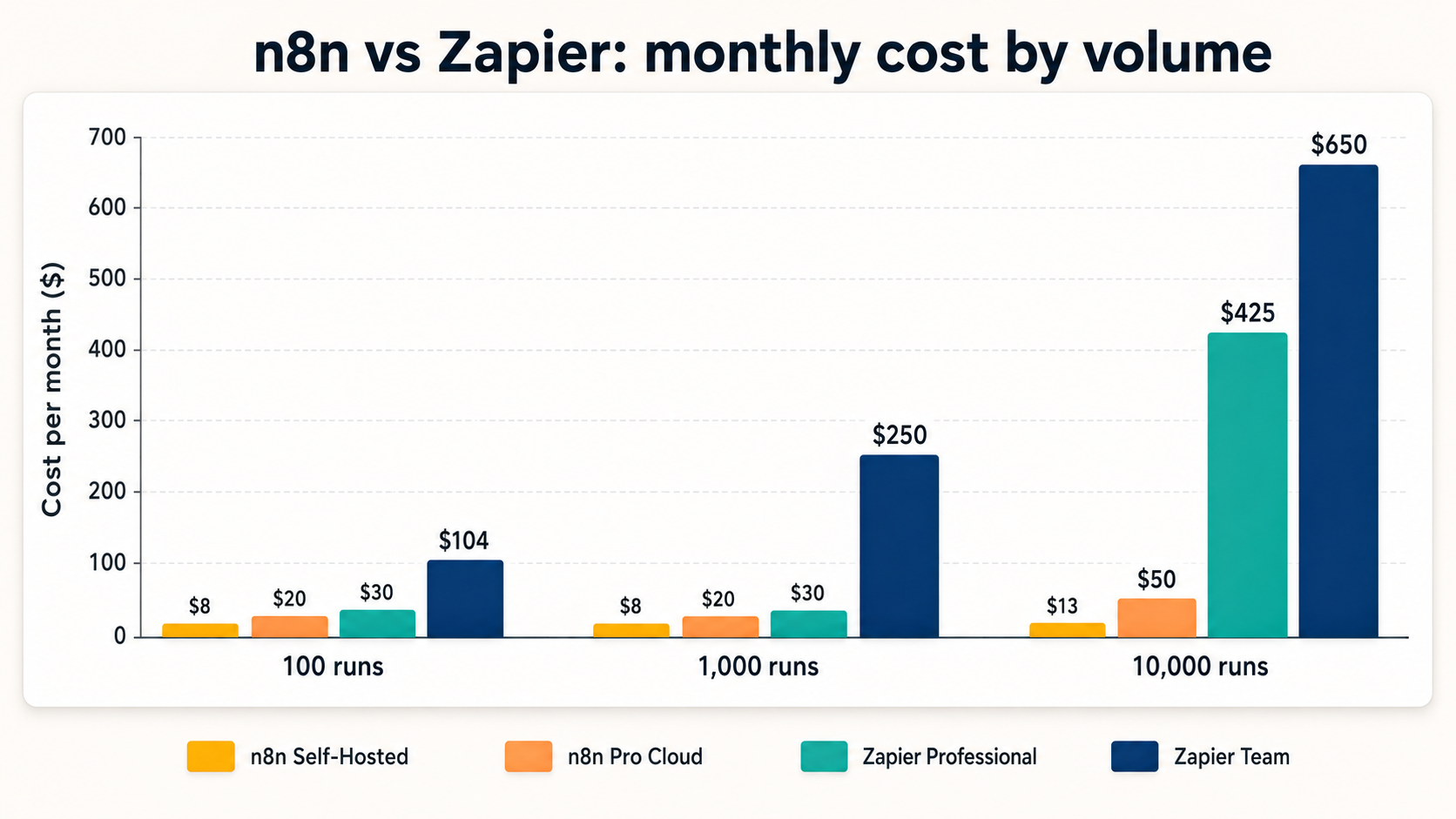
Here is what each tool costs across realistic usage, assuming an 8-step average workflow for Zapier. The pattern is clear. As runs go up, n8n stays cheap and Zapier climbs hard.
| Monthly Workflow Runs | n8n Self-Hosted | n8n Pro Cloud | Zapier Professional | Zapier Team |
|---|---|---|---|---|
| 100 runs | ~$6–$10/mo (server) | $20/mo | $29.99/mo (750 tasks covers this) | $103.50/mo |
| 1,000 runs | ~$6–$10/mo (server) | $20/mo | ~$29.99/mo (8,000 tasks needed, add-ons required) | ~$250+/mo |
| 10,000 runs | ~$10–$15/mo (server) | $50/mo | ~$350–$500+/mo (add-on task bundles) | ~$500–$800+/mo |
| 100,000 runs | ~$15–$30/mo (bigger VPS) | Enterprise pricing | Enterprise custom (likely $1,000+/mo) | Enterprise custom |
For any team running more than 1,000 complex executions per month, n8n self-hosted is dramatically cheaper, often 10 to 20 times cheaper than Zapier at the same volume.
The 2025 “Success Tax”: n8n’s Execution-Pricing Change Explained
If you are weighing n8n, you need to know about one change from 2025. It can raise your bill if your workflows run often. The fix is a simple design choice, and we will cover it.
On August 7, 2025, n8n changed how it bills higher-tier and enterprise plans. Before, limits were based on how many workflows you had active at once. Now, billing is based on the number of executions. One full end-to-end run equals one execution, no matter how many nodes, records, or API calls it processes inside.
Why does this matter? It changes the math for high-volume teams. A team running 50 workflows that each fire 1,000 times per month now pays for 50,000 executions, not just for having 50 workflows switched on. For real-time CRM sync, continuous lead processing, or high-frequency pipelines, costs go up under the new model.
Parts of the community call this a “success tax.” As your automation runs more, you pay more. n8n’s view is that the model is fairer, since you pay for actual usage, not for idle workflows. The practical move for any n8n user is to audit high-frequency workflows and ask whether they should run as a scheduled batch instead of trigger-per-event. That single change can cut executions by 80 to 90 percent with no loss of function.
Pro Tip: Before you scale, batch your high-frequency triggers. In our client builds, switching a per-event sync to a 15-minute batch run is the fastest way to keep execution costs flat as volume grows.
Ease of Use and Learning Curve
Zapier wins here, and it is not close. A non-technical user can ship a working automation in 15 to 30 minutes. n8n asks more of you up front but gives you far more control once you learn it.
Zapier’s guided interface, auto-field mapping, and thousands of templates mean you pick a trigger app, pick an action app, map the fields, and you’re done. There is no JSON to read, no detailed credential setup, and no canvas to navigate. n8n feels more like engineering software. Its node canvas expects you to understand JSON data, node connections, and expression syntax. Plan a 2 to 4 week learning curve if you have no automation background. For developers, though, n8n is actually more transparent, since you can inspect exactly what data passes between each node at every step.
| n8n | Zapier | |
|---|---|---|
| Time to first working workflow | 30–90 minutes (self-hosted setup included) | 10–15 minutes |
| Non-technical user accessibility | Moderate, requires some technical comfort | High, built for non-developers |
| Debugging capability | Excellent, step-through execution, pinned test data | Basic, task history view |
| Template library | 500+ community templates | Thousands of Zap templates |
| Learning resources | Growing docs + active community forum | Extensive documentation + Zapier University |
Integrations and Ecosystem
Zapier’s app library is its strongest card. n8n’s smaller library is offset by one node that connects to almost anything. Which matters more depends on the tools you use.
As of June 2026, Zapier lists 8,000+ native connectors, including 450+ AI-focused integrations. If you need to connect two niche tools fast, Zapier almost certainly has a ready-made connector with zero setup. n8n’s native library is smaller, with 400+ official nodes plus around 600+ community nodes, for a practical total above 1,000. The equaliser is n8n’s HTTP Request node. It connects to any service with a REST or GraphQL API, so the real integration universe is unlimited. The catch is that this takes more technical setup than clicking a native connector.
| n8n | Zapier | |
|---|---|---|
| Native integrations (June 2026) | 400+ official nodes | 8,000+ app connectors |
| Community/additional integrations | 600+ community nodes | Partner ecosystem |
| Custom API access | HTTP Request node, any REST/GraphQL API | Webhook + limited HTTP support |
| Integration depth | Deep, multiple operations and sub-resources per node | Varies, some apps have limited trigger/action options |
| Building custom integrations | Open-source, anyone can contribute nodes | Closed, must apply to Zapier’s partner program |
For mainstream tools like Slack, HubSpot, Salesforce, Gmail, Notion, Airtable, and Shopify, both platforms have solid native support. For very niche or legacy tools with weak API docs, Zapier’s ready-made connectors have a real edge. For internal APIs or custom infrastructure, n8n’s HTTP node and open-source design win clearly.
Workflow Logic, Branching, and AI Orchestration
This is where n8n’s design pulls ahead. Zapier handles simple, mostly linear flows. n8n handles the messy, branching, AI-driven logic that real businesses need.
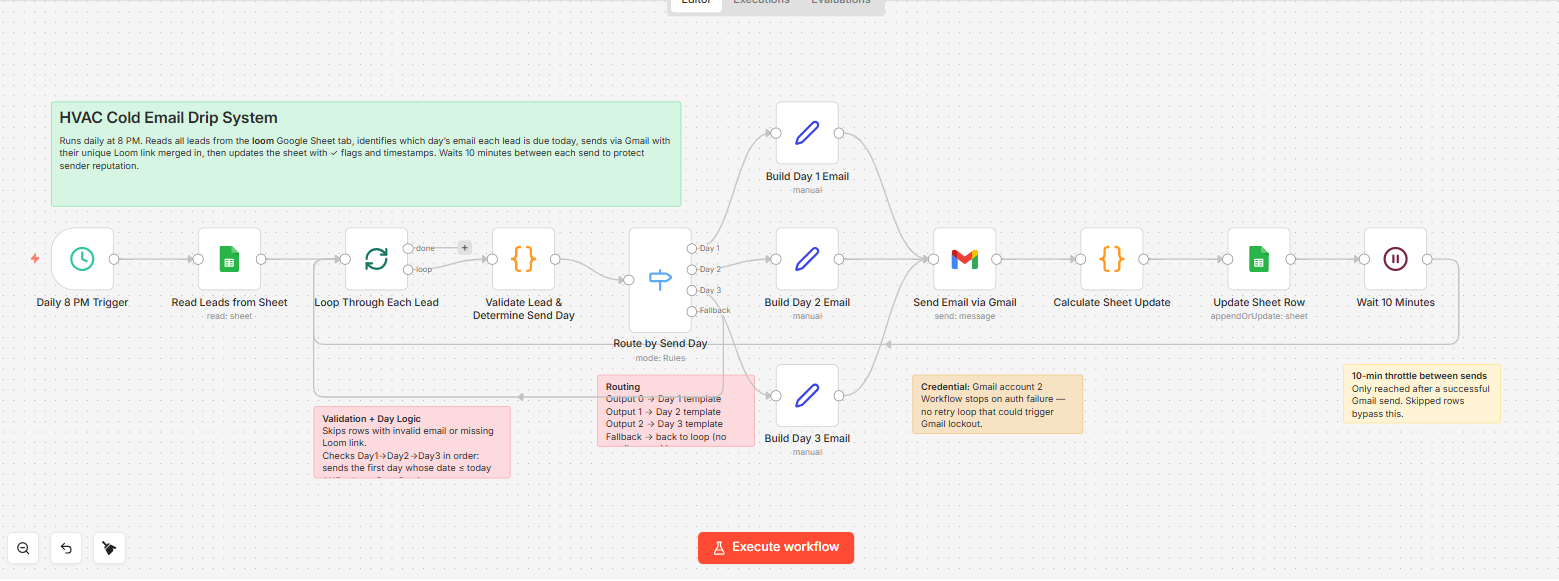
Zapier offers a basic “Paths” feature for branching, but it is limited to a few branches and cannot do loops, nested conditions, or dynamic branching based on live data. Its model is linear at heart. One trigger, a sequence of actions, and optional filters. n8n supports the full range developers expect. IF/ELSE conditions with unlimited branches, Switch nodes for multi-path routing, loop nodes (SplitInBatches) for arrays, error-handling sub-workflows, and parallel paths that merge later. It also includes native JavaScript and Python code nodes for logic that no UI can anticipate.
For AI work, n8n is in another category. The platform ships with:
- AI Agent node that builds autonomous agents using GPT-4o, Claude, Mistral, or local Ollama models, letting the AI decide at runtime which tools to call based on incoming data.
- LangChain integration with 70+ dedicated nodes for chains, memory, vector stores, embeddings, and RAG (Retrieval Augmented Generation) pipelines.
- Memory nodes that hold conversation context across executions for stateful chatbot or assistant workflows.
- Model flexibility to connect OpenAI, Anthropic, Google Vertex, HuggingFace, or any self-hosted LLM over HTTP.
Here is a real AI workflow shape in n8n:
Webhook trigger → Extract email text → OpenAI node (classify intent)
→ Switch node (route by intent)
   → Branch A: Query internal PostgreSQL knowledge base → Generate response → Send reply
   → Branch B: Escalate to Slack → Notify human agent
→ Log all executions to Airtable
Zapier can approximate the first few steps with its AI actions and ChatGPT connector. The branching depth, database query, and execution logging all need workarounds or extra Zaps.
Self-Hosting, Security, and Compliance
If your data cannot leave your own servers, this section decides everything. Zapier cannot be self-hosted. n8n can. For regulated work, that is the whole ballgame.
All Zapier data, execution history, credentials, and logic flow through its US-hosted servers. For healthcare, finance, legal, and government teams, or anyone under GDPR data residency rules, this is often a hard blocker. n8n can run on any infrastructure you control. A $6/month VPS, a private AWS VPC, an on-premises server, or a Kubernetes cluster with a Helm chart. When self-hosted, your data never touches n8n’s servers.
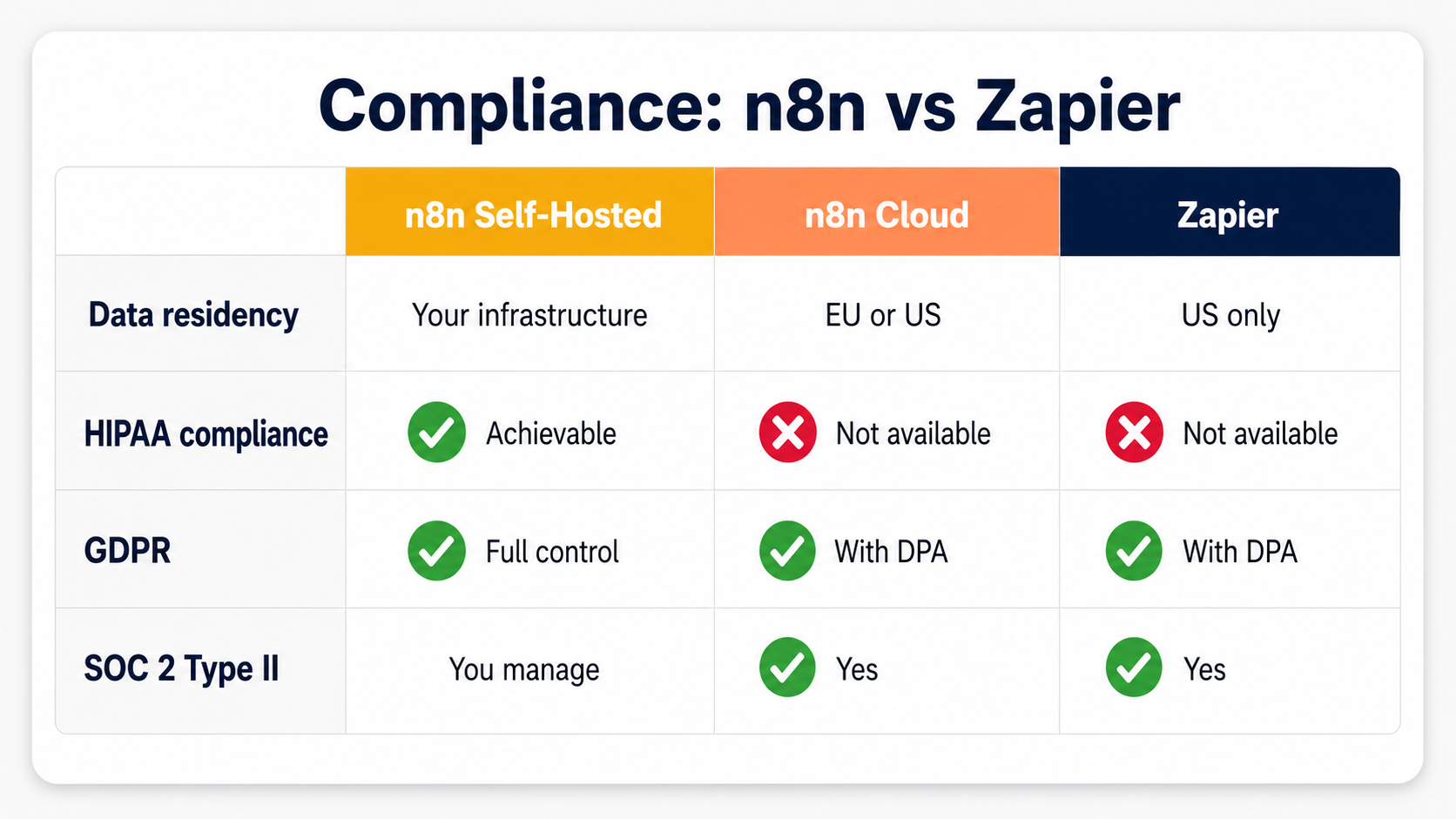
| Feature | n8n (Self-Hosted) | n8n Cloud | Zapier |
|---|---|---|---|
| Data residency | Fully in your own infrastructure | EU or US data centres | US-hosted only |
| SOC 2 Type II | You manage (depends on your hosting) | Yes | Yes |
| HIPAA compliance | Achievable, your infrastructure | Not available | Not available |
| GDPR | Full control | With DPA | With DPA |
| SSO / SAML / LDAP | Business+ plans | Business+ plans | Enterprise plan |
| Audit logs | Business+ plans | Business+ plans | Enterprise plan |
| Secrets management | Vault, AWS Secrets Manager integration | Managed | Managed |
| Git version control | Native (Business plan) | Native (Business plan) | No version control |
| Credential encryption | You control the keys | n8n manages | Zapier manages |
For any team in a regulated industry or with strict data sovereignty needs, n8n self-hosted is the only viable choice between these two.
The Real Total Cost of Ownership: What Nobody Tells You About Maintenance
“n8n self-hosted is free” is technically true and practically incomplete. When you self-host, you own the server and everything that breaks on it. The honest question forums keep asking is, who maintains this in six months when the person who built it leaves? Here is the full picture.
Hidden maintenance costs of self-hosting n8n
| Maintenance Task | Frequency | Hours/Month (Est.) | Cost at $75/hr Dev Rate |
|---|---|---|---|
| Server patching and OS updates | Monthly | 1–2 hrs | $75–$150 |
| n8n version upgrades (with testing) | Monthly–Quarterly | 1–3 hrs | $75–$225 |
| Node breakage after API changes | Occasional (avg. 1–2 per month) | 1–4 hrs | $75–$300 |
| Uptime monitoring and incident response | Ongoing | 0.5–2 hrs | $37–$150 |
| Backup verification and restore testing | Monthly | 0.5–1 hr | $37–$75 |
| Security review and credential rotation | Quarterly | 1–2 hrs amortised | $25–$50/month |
| Total estimated monthly overhead | 4–14 hours | $300–$950/month |
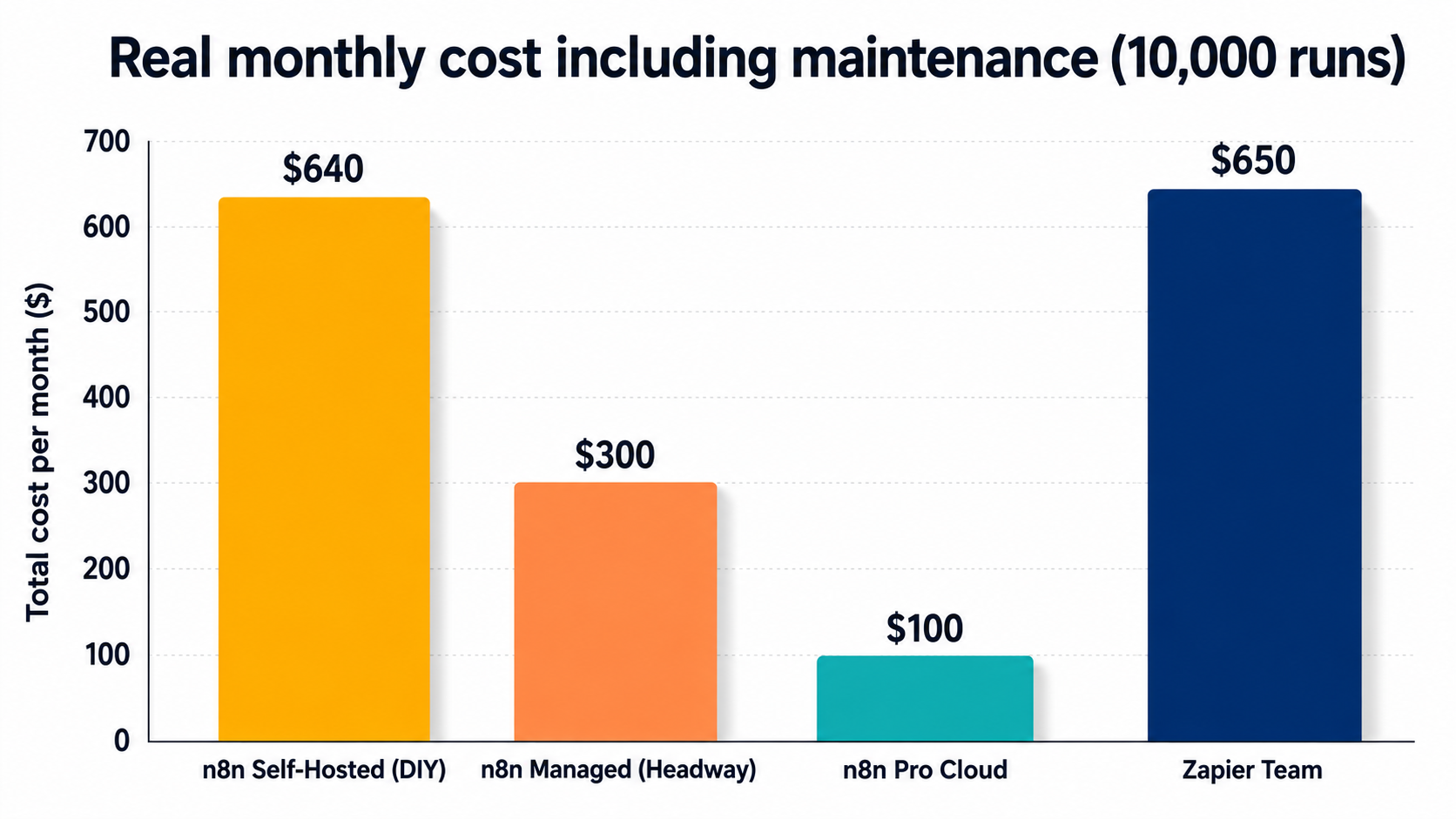
Now put software and maintenance together for a real 10,000-runs-per-month workload.
Net TCO comparison (after maintenance)
| Scenario | Software Cost/Mo | Maintenance Cost/Mo | Total TCO/Mo |
|---|---|---|---|
| n8n self-hosted (DIY, 10K runs/mo) | $10–$15 (server) | $300–$950 (dev time) | $310–$965/mo |
| n8n self-hosted (with Headway Automation managed support) | $10–$15 (server) | Fixed retainer (lower than DIY) | Significantly lower effective cost |
| n8n Pro Cloud (10K runs/mo) | $50 | $0–$100 (monitoring only) | $50–$150/mo |
| Zapier Team (10K runs/mo, 8-step avg) | $500–$800 | $0 (managed) | $500–$800/mo |
The honest conclusion is this. n8n self-hosted is cheapest when you have an in-house automation owner or a managed support partner. Without that, the hidden maintenance burden can quietly pass Zapier’s subscription at low-to-mid volume. The economics only become clearly favourable for self-hosted n8n when your team has dedicated technical capacity, or when a specialist agency handles upkeep for you. That is the exact gap we built our managed n8n service to fill, so you get n8n’s low software cost without the 2am incident calls.
Where Make, Relay.app, and Lindy Fit
The n8n vs Zapier debate often hides a third truth. The best tool for your case might be neither. Four alternatives come up again and again for specific needs.
| Platform | Pricing Model | Starting Price | Best For | Weakest At |
|---|---|---|---|---|
| n8n | Per execution | Free self-hosted / $20 cloud | Developers, AI workflows, data-sensitive industries, agencies | Non-technical users, quick setup |
| Zapier | Per task (step) | $29.99/month | Non-technical teams, niche SaaS connectivity, enterprise quick wins | Cost at scale, complex logic, compliance |
| Make (formerly Integromat) | Per credit (operation) | $9/month (Core, 10K ops) | Mid-complexity visual workflows, budget-conscious power users | AI agents, self-hosting, developer flexibility |
| Relay.app | Per run | $19/month | AI-assisted automation, small teams, human-in-the-loop workflows | Large integration library, complex logic |
| Lindy | Per action | $49.99/month (Plus) | AI-first use cases, conversational automation, sales/support agents | Developer customisation, cost at scale |
Make sits between Zapier and n8n. It offers a more visual, flowchart-style interface than Zapier, which makes complex branching easier to see, while staying cheaper for mid-volume work. Make switched from operations-based to credits-based billing in August 2025. Most standard actions still cost 1 credit, but advanced AI modules cost more based on tokens or file size.
Relay.app suits small teams who want AI-enhanced automation without developer overhead. At $19/month, it is the most accessible paid option, though its integration depth and logic are lighter than both Make and n8n. Lindy is built for AI-agent use cases like support agents, sales outreach, and meeting summaries. It works better as an AI workflow product than a general automation platform, and at $49.99/month for Plus it is the priciest of these at the entry level.
Good to Know: The “n8n vs zapier vs make” search is growing. If budget is your main constraint and you want a no-code tool with visual branching, Make at $9/month for 10,000 operations often beats Zapier’s $29.99 for 750 tasks.
Real-World Case Studies
Automation only matters if it produces results. These verified case studies show the kind of return teams get from each ecosystem.
- Vodafone (n8n): Overhauled its threat-intelligence pipeline with n8n, reportedly saving £2.2 million by automating data enrichment, alert routing, and security workflows that used to need heavy manual analyst time.
- Stepstone (n8n): The European job platform integrated more than 200 critical data workflows through n8n, reaching data integration speeds up to 25 times faster than its previous processes.
- Musixmatch (n8n): The music data platform reported saving 47 engineering-days of work in just 4 months by replacing custom-coded pipelines with n8n workflows.
- Delivery Hero (n8n): The global food delivery company used n8n to orchestrate complex operational workflows across many systems, letting its engineers move faster without custom integration code.
- Vendasta (Zapier ecosystem, via HatchWorks): A digital marketing platform reclaimed about $1 million in operational efficiency by automating client onboarding, reporting, and CRM workflows.
- SisterLove (Zapier ecosystem): A healthcare nonprofit automated donor engagement and program tracking, saving the equivalent of 282 workdays per year.
The pattern is consistent. The return from automation, whether n8n or Zapier, tends to be measured in hundreds of engineering hours or millions of dollars at scale. The platform you pick mainly affects how fast you get there and how much control you keep.
Agency Use vs In-House Use: Different Tools Win
The right tool changes based on who you build for. Building for your own internal team is a different problem than building for clients. Almost no comparison article makes this distinction, but it is one of the most practical questions buyers ask.
If you are an agency or automation freelancer building for many clients, n8n’s advantages are structural. You can deploy a separate n8n instance for each client on their own infrastructure, so their data never mixes, their credentials stay in their own environment, and you hand off a system they own outright. There is no per-task cost passed to the client as usage grows. When a workflow breaks at 2am after an API change, n8n’s step-through execution, pinned test data, and detailed error logs make the fix tractable. Zapier’s task history view is far weaker for fast troubleshooting.
If you are an in-house team with no dedicated automation engineer, Zapier’s managed infrastructure and simpler interface often make more sense. When the person who built the automations changes roles, a Zapier account is easier for a non-technical successor to understand and maintain than a self-hosted n8n instance. Zapier’s 24/7 managed uptime also matters when no one is on call.
The honest framing is short. n8n rewards technical ownership. Zapier rewards simplicity and support. Agencies who build and manage systems for clients, like us, almost always choose n8n for its flexibility, exportability, and zero vendor lock-in, so clients own the system, not the platform.
How to Migrate From Zapier to n8n
Every comparison article shows you how to build the same workflow in both tools. Almost none show you how to move an existing Zapier account to n8n. If you have outgrown Zapier’s pricing, this is the part you need.
First, learn the language. Most Zapier ideas map cleanly to n8n.
| Zapier Concept | n8n Equivalent |
|---|---|
| Zap | Workflow |
| Trigger | Trigger node (Webhook, Schedule, App trigger) |
| Action step | Node |
| Task (billing unit) | Execution (entire workflow = 1 unit) |
| Filter | IF node condition |
| Paths (branching) | Switch node |
| Formatter | Set node / Code node / built-in expressions |
| Delay | Wait node |
| Webhook trigger | Webhook node |
| Schedule trigger | Schedule trigger (cron) |
| Code step (JS) | Code node (JavaScript or Python) |
Then follow these steps.
- Audit your Zaps. Export a list of all active Zaps. Note the trigger app, each action, filters, and paths. Find the 5 to 10 Zaps that use the most tasks each month. Those are your highest-value migrations.
- Set up n8n. Deploy self-hosted via Docker on a $10/month VPS in under 30 minutes, or sign up for n8n Cloud for a managed environment.
- Rebuild credential connections. Every integration in n8n needs its own API keys or OAuth setup. Plan 15 to 30 minutes per unique service.
- Rebuild high-priority workflows first. Map Zapier triggers to n8n trigger nodes, then rebuild each action as a node. For any app without a native node, use the HTTP Request node with the app’s API docs.
- Run parallel validation. Keep Zapier active for 1 to 2 weeks while you test the n8n versions on real data. Compare outputs before you switch anything off.
- Cancel Zapier. Once every workflow is stable in n8n, cancel your subscription. Export any Zap documentation to your own records first.
A simple 3-step Zap takes 30 to 60 minutes to rebuild. A complex multi-path workflow with custom formatting takes 2 to 4 hours. Most teams finish a full migration in 2 to 4 weeks. The hardest migrations use Zapier Formatter, so plan extra time to rebuild that logic with n8n’s Set node or Code node.
Best Practice: Migrating back from n8n to Zapier follows the same map in reverse, but with one big catch. n8n is open-source and exports as JSON, so you can take your entire workflow library out at any time. Zapier has no export. Cancel it and you lose your Zap configurations. That portability gap is one of the strongest practical arguments for n8n.
Decision Matrix: Which Tool Wins in Which Scenario
You do not need to weigh every feature. Find your situation in this table and you have your answer.
| Scenario | Best Choice | Why |
|---|---|---|
| Non-technical team needing automation today | Zapier | Fastest setup, guided interface, no infrastructure |
| Connecting two niche SaaS apps with no API docs | Zapier | 8,000+ native connectors, likely already supported |
| High-volume automations (>5,000 runs/month) | n8n | Execution pricing is 5–20x cheaper than per-task billing |
| Data must stay inside your own infrastructure | n8n Self-Hosted | Zapier’s cloud-only model is a hard blocker |
| Building AI agent workflows (LangChain, RAG, memory) | n8n | Native 70+ AI nodes, LangChain integration, tool-use routing |
| Regulated industry (healthcare, finance, government) | n8n Self-Hosted | HIPAA, data residency, and compliance only achievable self-hosted |
| Agency building automation for clients | n8n | Client-owned infrastructure, zero vendor lock-in, debuggable |
| Solo founder or non-technical business owner | Zapier or Make | n8n learning curve not worth it without technical support |
| Budget is zero or near-zero | n8n Self-Hosted | ~$6–$10/month server cost vs Zapier’s $29.99 minimum |
| In-house team with no dedicated automation owner | Zapier | Managed uptime, easier handoff, no maintenance burden |
| Developer needing custom code in workflows | n8n | Native JS + Python nodes; Zapier’s code step is very limited |
| Avoiding vendor lock-in | n8n | Open-source, exportable as JSON, no proprietary format |
| Visual mid-complexity flows on a tight budget | Make | Cheaper than Zapier, more visual than n8n, good middle ground |
| AI-first conversational agents (sales/support) | Lindy | Built specifically for AI agent use cases |
Who Should Not Use n8n (and Who Should Stay Off Zapier)
Most articles only tell you who each tool is good for. The more useful and honest test is the opposite. Where will each one let you down?
Do not use n8n if:
- You have no technical capability in-house and no plan to hire or partner with a specialist. You will get stuck during setup, credential config, or the first time a node breaks after an API update.
- You need a working automation in the next 2 hours and have never used the platform. n8n’s learning curve makes same-day results unlikely for first-timers.
- Your team changes often and non-technical successors must manage workflows without training. A self-hosted n8n instance with no documentation becomes a maintenance liability.
- You need to connect several niche SaaS tools that have no public REST API and no Zapier connector. n8n’s HTTP node needs an API to work with. No API, no help.
Do not use Zapier if:
- Your workflows process sensitive data like health records, financial information, or PII, and you are under HIPAA, strict GDPR residency, or any rule that bars data from leaving your infrastructure. Zapier is a hard no here.
- Your automations run at scale, more than 5,000 complex runs per month. Per-task billing makes Zapier exponentially expensive and structurally unviable as you grow.
- You need custom code, loops, complex branching, or integration with non-standard internal systems. Zapier will push you into workarounds that become technical debt.
- You are an agency building systems clients need to own. Zapier’s closed format and account-bound structure make handoff messy and keep clients dependent on you.
- You are building AI-agent workflows where the AI must reason, choose tools dynamically, and keep memory across sessions. Zapier’s AI Actions are task-based call-and-response, not true agent architecture.
Frequently Asked Questions
Is n8n better than Zapier in 2026?
n8n is better for developers, technical teams, high-volume automations, AI agent workflows, and any case where data sovereignty or compliance matters. Zapier is better for non-technical users who need the fastest setup and the widest native integration library. Neither is universally better. The right choice depends on your team’s technical skill and how complex your workflows are.
Is n8n really free?
n8n’s Community Edition (self-hosted) is free forever. You pay only server costs, typically $6 to $15/month on a basic VPS for most small-to-medium workloads. n8n Cloud starts at about $20/month for 2,500 executions. Zapier’s free plan caps at 100 tasks/month and 3 active Zaps, which is rarely enough for real business automation.
How much does n8n cost vs Zapier at scale?
At 10,000 runs per month (8-step average complexity), n8n self-hosted costs $10 to $15/month in server fees, and n8n Pro Cloud costs $50/month. Zapier at the same volume (80,000 tasks) needs add-on task bundles, pushing costs to $350 to $800+/month depending on tier. The gap widens as volume grows.
What is n8n’s execution pricing change from 2025?
In August 2025, n8n shifted from limiting the number of active workflows to billing based on executions for higher-tier plans. One execution equals one full end-to-end run, regardless of internal complexity. This rewards complex workflows, since a 50-node workflow still costs one execution, but it means teams should audit high-frequency automations to manage costs at scale.
Can n8n replace Zapier entirely?
For technical teams, yes, completely. n8n can replicate every Zapier use case with native nodes, the HTTP Request node, or custom code, and every major Zapier integration has an n8n equivalent. For non-technical users who need zero-setup automation across niche SaaS apps, Zapier’s 8,000+ connector library is still a real advantage that n8n cannot fully match without technical setup.
Is n8n good for non-technical users?
It is workable but takes patience. Expect a 2 to 4 week learning curve. n8n’s node canvas and JSON handling need more technical comfort than Zapier’s guided interface. Non-technical users who want power without developer involvement are better served by Zapier (simplest) or Make (visual, mid-complexity) until they have technical support for n8n.
What is the difference between n8n tasks and Zapier tasks?
The terms are different. In Zapier, a “task” is one action step, so a 5-step Zap running 1,000 times uses 5,000 tasks. In n8n, an “execution” is one full run, so a 50-node workflow running 1,000 times uses 1,000 executions. This billing difference makes n8n much cheaper for complex multi-step workflows at any real volume.
Is n8n or Zapier better for GDPR and HIPAA compliance?
n8n self-hosted is the only option between the two for strict GDPR residency or HIPAA compliance. When self-hosted, all data stays inside your own infrastructure and Zapier’s servers never see it. Zapier is GDPR-compliant with a Data Processing Agreement but processes data on its US-hosted servers, which fails strict residency rules and is not viable for HIPAA-regulated workflows.
How long does it take to migrate from Zapier to n8n?
A simple 3-step Zap takes 30 to 60 minutes to rebuild. A complex multi-path workflow with custom formatting may take 2 to 4 hours. Most teams finish a full migration in 2 to 4 weeks. Run both platforms in parallel for 1 to 2 weeks before switching off Zapier, so you can confirm outputs match on real data.
What automation tool is best for agencies?
Agencies building automation for clients are best served by n8n. Its open-source, self-hosted design lets you deploy on the client’s own infrastructure, hand off systems the client owns outright, and keep full transparency over what the system does. Zapier’s account-bound, proprietary format creates ongoing dependency on the agency and gives clients no portability.
The Bottom Line
n8n wins on cost, control, and AI capability. Above roughly 1,000 complex runs per month, it is dramatically cheaper than Zapier, and its native LangChain integration, AI Agent node, and self-hosting make it the clear pick for technical teams and AI-first workflows. Zapier wins on speed and accessibility, with 8,000+ connectors and a guided interface that non-technical teams genuinely love. The 2025 execution-pricing change means high-frequency teams should audit their workflows, and self-hosting is only truly cheap once you account for maintenance or hand it to a managed partner. Make is the overlooked middle option, data sovereignty is n8n’s decisive edge in regulated industries, and agencies should choose n8n almost every time.
Pick Zapier to start fast. Pick n8n to own what you build and stop paying more every time your business grows.
Published by Headway Automation, specialists in custom n8n workflows for small and mid-sized businesses. We build lead capture, CRM automation, AI voice agent, and reporting systems that save teams 10+ hours every week without expensive monthly software fees.